
By Lizza | Lizzique Media | Updated 2026
You’ve built the store, uploaded the products and launched. Now comes the hard part: getting strangers to find you, trust you and buy. Whether you sell on Shopify, WooCommerce or another platform, ecommerce marketing is the set of strategies that brings in shoppers, turns them into customers and brings them back for more.
This complete ecommerce marketing guide walks through every channel that matters in 2026: SEO, paid ads, email, social media, conversion optimization, influencers and analytics. You will also find a simple framework for choosing where to start, what to measure and how to grow without wasting budget.
Key takeaway: Ecommerce marketing isn’t one tactic. It is a system: attract the right visitors, convert them, then keep them buying.
In this guide:
- What is ecommerce marketing?
- The ecommerce marketing funnel
- Step 1: Get your foundation right
- Step 2: Ecommerce SEO
- Step 3: Paid ads (Google Shopping, Meta and more)
- Step 4: Email and SMS marketing
- Step 5: Social media and influencer marketing
- Step 6: Conversion rate optimization
- Step 7: Retention and customer loyalty
- Step 8: Track the right numbers
- Which channel should you start with?
- Common ecommerce marketing mistakes
- 30-day ecommerce marketing action plan
- FAQs
What Is Ecommerce Marketing?
Ecommerce marketing is the practice of promoting an online store and driving traffic, sales and repeat purchases through digital channels. It covers everything from the search results where shoppers first find you to the email that brings them back for a second order.
It differs from general marketing in a few important ways:
- Your website is the shop. Every page is both a marketing asset and a sales page.
- Everything is measurable. You can see which channel produced which sale, and what it cost.
- Competition is a click away. Shoppers compare prices and reviews in seconds.
- Repeat customers drive profit. Winning a customer is expensive, so keeping them matters as much as finding them.
The Ecommerce Marketing Funnel
Think of your marketing in four stages. Each stage needs different content and channels.
| Stage | Shopper’s mindset | Best channels |
|---|---|---|
| Awareness | “I have a problem or a want” | SEO content, social media, influencers, video ads |
| Consideration | “Which product or brand is best?” | Product pages, reviews, comparison content, retargeting ads |
| Purchase | “I’m ready to buy” | Google Shopping, search ads, strong product pages, easy checkout |
| Retention | “Should I buy again?” | Email, SMS, loyalty programs, great support |
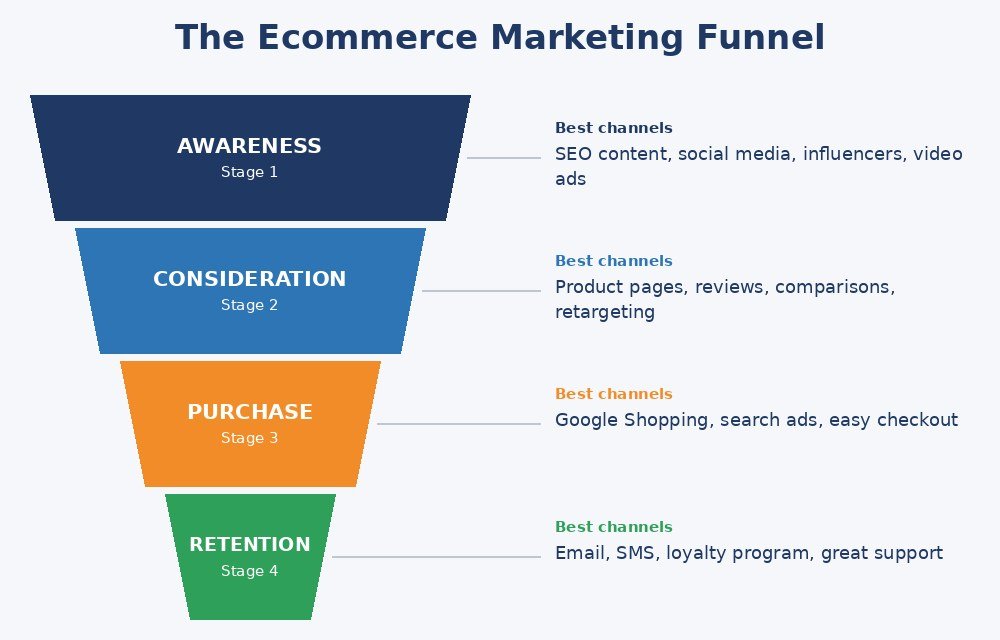
Important: Most stores spend nearly everything on the first two stages and neglect the last two. Retention is usually the cheapest source of revenue.
Step 1: Get Your Foundation Right
Marketing sends visitors to your store. If the store isn’t ready, you pay for traffic that doesn’t convert. Check these first:
- Fast, mobile-friendly site. Most shoppers browse on their phones.
- Clear product pages with good photos, honest descriptions, sizes, shipping information and reviews.
- Simple checkout. Offer guest checkout, popular payment methods and clear delivery costs and times.
- Trust signals: return policy, contact details, secure payment badges and real customer reviews.
- Analytics installed: GA4, your ad platform pixels and Google Search Console, set up correctly before you spend a cent on ads.
- A clear offer: who you sell to, why you are different and what makes buying from you low-risk.
Pro tip: Place an order on your own store using your phone. Every moment of friction you notice is costing you sales.
Step 2: Ecommerce SEO
SEO brings in shoppers who are already searching for what you sell, and the traffic keeps coming without paying per click. It takes time, but it often becomes the lowest-cost channel.
Where to focus:
- Keyword research: find terms shoppers use, such as “waterproof hiking backpack” or “best running shoes for flat feet”.
- Category pages: these usually target your most valuable keywords, so give them unique intro text, not just a grid of products.
- Product pages: unique titles and descriptions, clear headings, image alt text, and reviews. Avoid copying manufacturer descriptions.
- Site structure: keep important pages within a few clicks of the homepage, and use clean, short URLs.
- Technical health: fast loading, mobile friendliness, no broken links, and a sitemap in Google Search Console.
- Content marketing: buying guides, comparisons and how-to posts that attract shoppers earlier in the funnel and link to your products.
- Structured data: product schema helps search engines show prices, availability and ratings. “Google’s product structured data guidelines”.
Step 3: Paid Ads for Ecommerce
Paid ads bring results quickly, which makes them useful for launches, sales and testing products. They only pay off if your numbers work, so know your margins first.
Main ad channels:
- Google Shopping and Performance Max: show your products with photos and prices to people actively searching. This is often the highest-intent channel. “Google’s guide to getting started with Merchant Center”.
- Google Search ads: capture shoppers searching for specific products or brands.
- Meta ads (Facebook and Instagram): great for discovery and retargeting, using strong visuals and video.
- TikTok, Pinterest and YouTube: worth testing if your product is visual and your audience is active there.
- Retargeting: show ads to people who viewed products or abandoned their cart. These often cost less per sale than cold traffic.
Before you spend:
- Know your break-even ROAS (the return on ad spend you need to cover product cost, shipping and fees).
- Start small, test a few creatives and audiences, then scale what works.
- Make sure conversion tracking is accurate.
Warning: A high ROAS on paper can still lose money once returns, shipping, discounts and payment fees are included. Always check profit, not only revenue.
Step 4: Email and SMS Marketing
Email is one of the most profitable ecommerce channels, because you own the list and don’t pay per impression. Start collecting emails from day one.
Set up these automated flows first:
- Welcome series: introduce your brand and give new subscribers a reason to buy.
- Abandoned cart: remind shoppers about items left behind, often over 2 to 3 messages.
- Browse abandonment: follow up with people who viewed a product but never added it to the cart.
- Post-purchase: confirm the order, share usage tips, ask for a review and suggest related items.
- Win-back: re-engage customers who haven’t bought in a while.
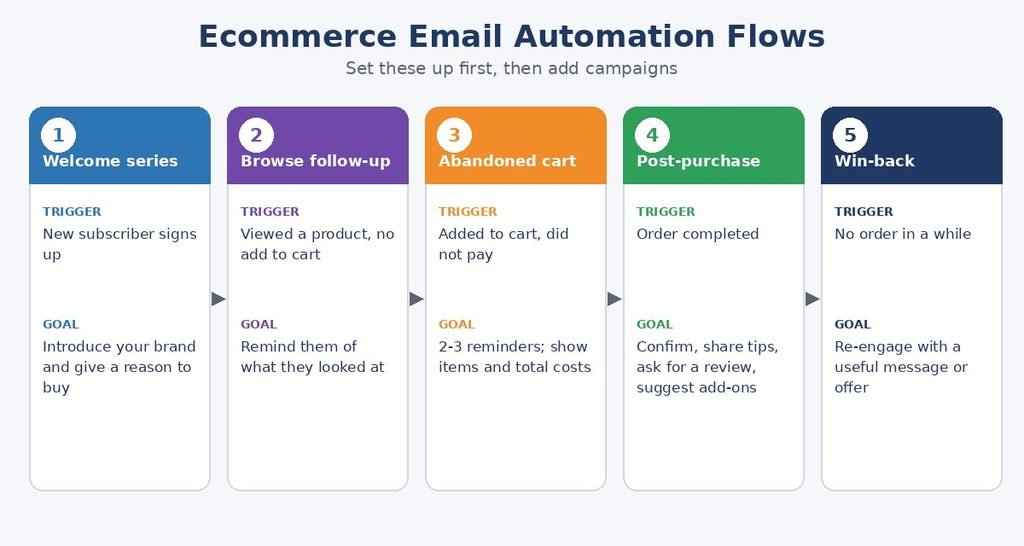
Then add campaigns: new arrivals, sales, restocks and useful content.
Good practices:
- Build your list with a clear, honest incentive for signing up.
- Segment by behavior, such as first-time buyers versus repeat customers.
- Use SMS sparingly and only with proper consent.
- Follow the email and messaging laws that apply where your customers live.
Step 5: Social Media and Influencer Marketing
Social media builds awareness and trust, and it gives you content to reuse in ads and emails.
What works:
- Show the product in use. Short videos, demos and unboxings beat polished catalog shots.
- Use customer content (UGC). Real photos and reviews build trust faster than brand claims.
- Pick one or two platforms where your customers actually spend time, instead of posting everywhere.
- Work with influencers whose audience matches your buyers. Micro-influencers often deliver better engagement and value than celebrities.
- Make buying easy with links, shop features and clear calls to action.
When working with influencers:
- Agree on deliverables, usage rights and payment up front.
- Use unique discount codes or tracked links to measure results.
- Make sure sponsored posts are clearly disclosed, as advertising rules require.
Step 6: Conversion Rate Optimization (CRO)
Getting 10% more sales from the traffic you already have is often cheaper than getting 10% more traffic. Conversion rate optimization improves the share of visitors who buy.
High-impact improvements:
- Better product images and video, with multiple angles and context shots
- Clear, benefit-led descriptions and a scannable layout
- Customer reviews and ratings on product pages
- Visible shipping, returns and delivery information
- A faster, simpler checkout with fewer form fields
- Urgency and scarcity that are genuine, such as real stock limits or sale end dates
- Product recommendations, like bundles and “frequently bought together”
- Exit offers or reminders for visitors who are about to leave
Pro tip: Test one change at a time and let each test run long enough to collect meaningful data. Don’t judge results from a handful of orders.
Step 7: Retention and Customer Loyalty
Repeat customers cost less to win and usually spend more over time. Build retention into your marketing:
- Great post-purchase experience: fast delivery, clear tracking and helpful support
- Loyalty or rewards program that fits your product and margins
- Subscriptions or replenishment reminders for products people reuse
- Personalized recommendations based on past purchases
- Review and referral requests at the right time
- A community, through email, social or user groups
Track customer lifetime value (CLV) so you know how much you can afford to spend to acquire a customer.
Step 8: Track the Right Numbers
Measure what connects to profit, not just traffic.
| Metric | What it tells you |
|---|---|
| Conversion rate | The share of visitors who buy |
| Average order value (AOV) | How much a typical order is worth |
| Customer acquisition cost (CAC) | What it costs to win one customer |
| Return on ad spend (ROAS) | Revenue generated per unit of ad spend |
| Customer lifetime value (CLV) | Total value of a customer over time |
| Cart abandonment rate | How many shoppers leave before paying |
| Repeat purchase rate | How well you keep customers |
| Email revenue share | How much of your revenue your list generates |
Use GA4, your ad platforms and your ecommerce platform reports together, and review them weekly.
Which Channel Should You Start With?
There’s no single right answer, but this is a practical order for most small and growing stores:
- Fix the foundation: product pages, checkout and tracking
- Set up email capture and core automations (low cost, high return)
- Launch Google Shopping or search ads if you have healthy margins and need sales now
- Add Meta retargeting, then prospecting once your creative is working
- Build SEO and content in parallel for long-term growth
- Add influencers and UGC once you have a proven product and offer
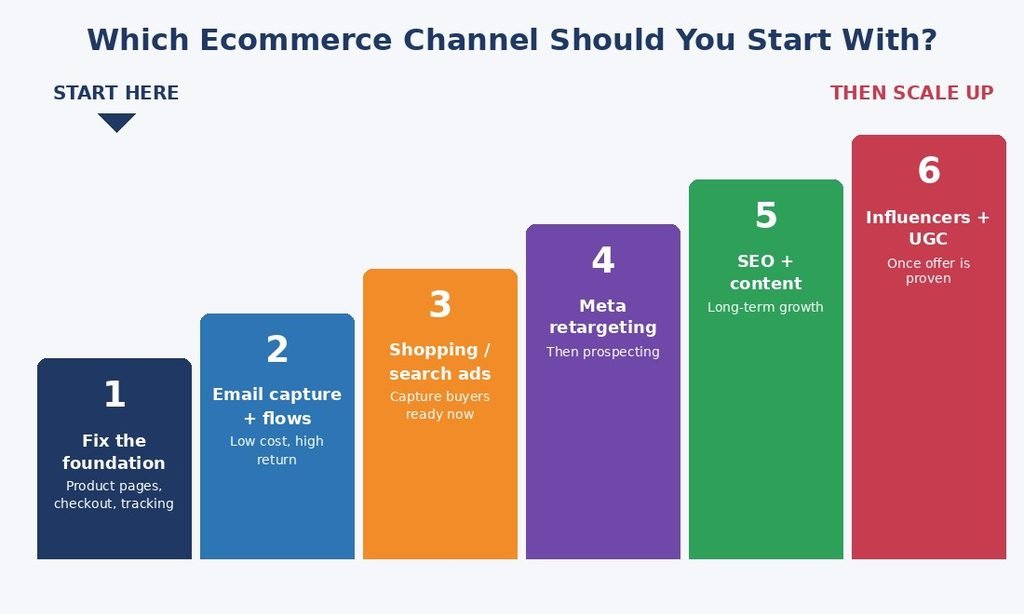
Key takeaway: Start with the channels that capture existing demand and recover lost sales. Add the ones that create new demand once your store converts well.
Common Ecommerce Marketing Mistakes
- Driving paid traffic to a store that isn’t ready to convert
- Ignoring profit margins and judging campaigns only on revenue
- Not tracking properly, so you can’t tell which channel works
- Copying manufacturer product descriptions, which hurts SEO and trust
- Neglecting email, and relying only on paid ads
- Spreading across too many channels with too little budget
- Skipping reviews and social proof
- Never testing, whether creatives, offers or pages
- Forgetting existing customers while chasing new ones
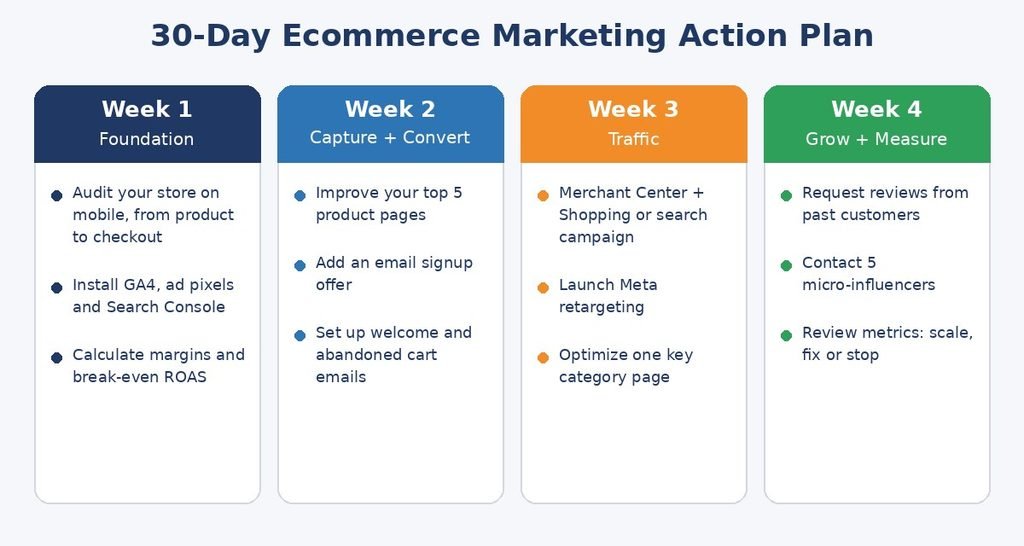
Your 30-Day Ecommerce Marketing Action Plan
Week 1: Foundation
- Audit your store on mobile, from product page to checkout
- Install and verify GA4, ad pixels and Search Console
- Calculate your margins and break-even ROAS
Week 2: Capture and convert
- Improve your top 5 product pages
- Add an email signup offer
- Set up welcome and abandoned cart emails
Week 3: Traffic
- Set up Google Merchant Center and a Shopping campaign, or a search campaign
- Launch a small Meta retargeting campaign
- Optimize one key category page for SEO
Week 4: Grow and measure
- Request reviews from past customers
- Reach out to 5 relevant micro-influencers
- Review your metrics, and decide what to scale, fix or stop
Frequently Asked Questions About Ecommerce Marketing
What is ecommerce marketing?
Ecommerce marketing is the use of digital channels such as SEO, paid ads, email and social media to bring shoppers to an online store, convert them into buyers and encourage repeat purchases.
What is the best ecommerce marketing strategy for a small store?
Start by fixing your product pages, checkout and tracking. Then set up email automations, add search or shopping ads for quick sales, and build SEO and content for long-term growth.
How much should I spend on ecommerce marketing?
It depends on your margins, goals and stage. Many stores set a percentage of revenue as a budget, but the better question is what you can afford to pay to acquire a customer, based on profit and lifetime value.
Is SEO or paid advertising better for ecommerce?
Neither is better in every case. Ads bring faster sales but stop when you stop paying. SEO takes longer but builds lasting traffic. Most successful stores use both.
How long does ecommerce SEO take?
Expect early movement in about 3 months and stronger results in 6 months or more, depending on competition, your site’s health and how consistently you publish and optimize.
Which ad platform is best for ecommerce?
Google Shopping suits shoppers who are ready to buy, and Meta suits discovery and retargeting. The best choice depends on your product, audience and budget, so test before you scale.
How do I reduce cart abandonment?
Show total costs early, offer guest checkout and trusted payment options, speed up the site, and send abandoned cart emails.
What is a good ROAS for ecommerce?
There’s no universal number. A good ROAS is one above your break-even point after product cost, shipping, fees and returns, so work out your own margin first.
Do I need an agency for ecommerce marketing?
Not always. Many owners start on their own. An agency can help once you want to scale, need specialist skills such as paid ads or SEO, or lack the time to manage everything.
Final Thoughts
Ecommerce marketing works best as a system: make your store ready to convert, capture demand with search and shopping ads, build owned channels like email and SEO, and track your profit, not just your traffic. Start with a few channels, do them well, and add more as your results allow.
If you’d rather have an expert handle it, Lizzique Media helps ecommerce brands grow with SEO, paid ads, email and conversion optimization.
Contact us for a free ecommerce marketing audit.
Read next: